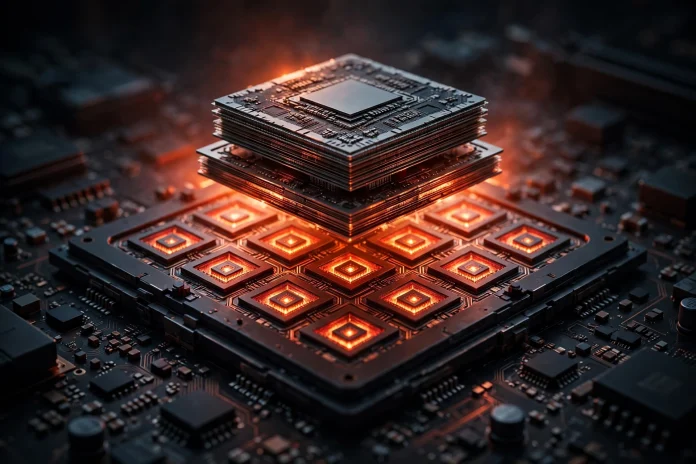
I have a confession. I bought a 12-core Ryzen 9 9900X last year. 12 cores. 24 threads. $450. I felt like a genius. Then I played Cyberpunk. And my friend with the cheaper 8-core 9800X3D — 4 fewer cores, $20 less — got 15% MORE fps than me. I was furious. I had MORE cores. How did I lose? That question is the entire story of Zen 6.
AMD’s Zen 6 — codename Morpheus, desktop codename Olympic Ridge / Medusa Ridge, expected as Ryzen 10000 in H1 2027 (CES 2027) — puts 12 full P-cores + 48MB L3 cache on ONE chiplet, up from 8 cores + 32MB in Zen 5. That’s +50% cores and cache per chiplet. PCWorld — With Zen 6, AMD’s Next Great Gaming CPU Could Have It All, Nov 10 2026
It also rebuilds the core for ~27% IPC uplift in Zen 6c server tests (not gaming, read the caveat), better branch prediction, 6,750-entry op cache, up to 18 ops/cycle. PCWorld And Venice-X proves 12 cores + 144MB L3 (48MB + 96MB 3D V-Cache) is possible on one chiplet. PCWorld Translation: The next 12-core Ryzen X3D could finally be ONE chiplet, no cross-chiplet lag, no Windows scheduling mess, 4 extra cores + huge cache + faster core. If AMD prices it right and DDR5 doesn’t bankrupt you, this is the first CPU in 7 years that has it ALL — cores + cache + speed — in one chip.
The 8-Core Prison — Why AMD Was Stuck For 7 Years
To understand Zen 6, you need to understand a chiplet.
Imagine a CPU is not one big chip. It’s Lego.
AMD’s Lego brick is called a CCD — Core Complex Die. It’s a little chip with cores + cache on it. Ryzen CPUs are 1 or 2 CCDs glued to an I/O die that talks to RAM, USB, PCIe.
“A core complex die (CCD) is a group of CPU cores sharing a pool of fast L3 cache, which keeps frequently used data close instead of forcing trips to slower system memory.” PCWorld
Since Zen 2 (2019) through Zen 5 (2024), every CCD had 8 cores. No more. No less.
Want 8 cores? 1 CCD. Want 16 cores? 2 CCDs. Want 12 cores? You can’t have 12 on one CCD. You have to do 6+6 across two CCDs.
“The first two Ryzen generations maxed out at four cores per CCX, or eight cores per dual-CCX chip. Zen 3 through 5 upped that total to eight cores per CCX, pushing overall core counts to a new high of 16. Zen 6 goes even further, with Venice-X upping the tally to a whopping 12 cores per CCX.” PCWorld / PCWorld July 30 2026 — Next-gen Ryzen Could Be A Monster
Why did 8 cores matter for gaming?
Games love cache. Games love low latency. Games HATE waiting for data from another chiplet.
Here’s what happened with my 9900X:
- My 12 cores were split: 6 on CCD0, 6 on CCD1.
- Game starts on CCD0, needs data from CCD1? It has to travel: CCD0 -> I/O Die -> CCD1 -> back. That’s like calling your neighbor to ask for sugar instead of opening your own pantry. It’s slow.
- Windows tries to keep game on ONE CCD to avoid this. But if game needs more than 6 cores, it spills over. Now you’re paying latency tax.
- 9800X3D has only 8 cores, but ALL 8 on ONE CCD, plus 96MB of 3D V-Cache stacked on top. No travel. No tax. All game data sits right next to cores.
“Current 12-core Ryzen processors need two chiplets. Communication between separate CCDs introduces additional latency, especially in games that distribute their workloads across both.” Notebookcheck — Zen 6 Could Bring 24-Core Ryzen, Nov 10 2026
“Existing 12-core Zen 5 Ryzen processors distribute their cores across two CCDs. Communication across that boundary can introduce additional latency.” WindowsForum — Zen 6: 12-Core Chiplet and 144MB Cache, Nov 10 2026
That’s why 8-core X3D beat 12-core non-X3D. Not because 12 cores is bad. Because 12 cores split across 2 CCDs is bad for games.
Zen 6 Breaks The Prison — 12 Cores, One Chiplet, One Cache
Zen 6 changes the Lego brick.
“AMD’s Zen 6 architecture puts 12 full-performance cores and 48MB of shared L3 cache on a single chiplet, up from eight cores and 32MB with Zen 5. That’s a 50 percent jump in both.” PCWorld
| Zen 5 (Ryzen 9000, Today) | Zen 6 (Ryzen 10000, 2027) | Change | |
| Cores per CCD | 8 | 12 | +50% |
| L3 Cache per CCD | 32MB | 48MB | +50% |
| Cache per Core | 4MB | 4MB | Same — important caveat |
| Max Cores (2 CCDs) | 16 | 24 | +50% |
| Max L3 (2 CCDs, No X3D) | 64MB | 96MB | +50% |
| Process Node | TSMC 4nm (N4P) | TSMC 2nm (N2P) | 2 generations jump |
| Socket | AM5 | AM5 (through 2029) | Same board! |
Table Sources: PCWorld Wikipedia — Zen 6, TSMC N2P CCD + N6 IOD, AM5, Desktop H1 2027 TechSpot — AMD Documents Confirm Zen 6 Desktop Will Support AM5, Aug 27 2026
What does 12 cores on ONE CCD actually mean for you?
- A future 12-core Ryzen could fit entirely on one CCD. “With 12 cores sharing 48MB of L3 cache, a future 12-core Ryzen could fit entirely on one CCD.” PCWorld No split. No cross-CCD latency. No Windows scheduling gymnastics.
- Games that use 9-12 cores finally get full speed. “Games capable of keeping more than eight cores busy could benefit without spreading that work across two CCDs.” PCWorld In 2027, games like GTA VI PC, Battlefield, Star Citizen, Microsoft Flight Simulator 2024, and Unreal Engine 5 games are using 10-12 threads. They were punished before. Now they’re rewarded.
- Streaming + Gaming at same time, no compromise. Before: Game on CCD0, OBS / Discord / Chrome on CCD1, they fight. Now: Game + stream on same CCD, sharing same 48MB cache, no fight.
The caveat PCWorld buried: “Though the cache-per-core ratio remains unchanged at 4MB.” PCWorld
“50% more total cache does not mean more cache per core. The reported configurations both average 4MB of shared L3 per core.” WindowsForum
Each core doesn’t get MORE cache. The POOL gets bigger because there are more cores. But if a game uses all 12 cores, each core still gets 4MB on average. The win is that all 12 cores share ONE pool, not two separate 32MB pools that can’t talk fast.
The Brain Upgrade — IPC, Branch Prediction, And Why “More GHz” Is Lying
Everyone obsesses over GHz. “Zen 6 will hit 7 GHz!” “No, 6.4 GHz!” “No, 6.5 GHz!”
Ignore GHz for a second. The real upgrade is IPC — Instructions Per Cycle. How much work a core does in ONE clock tick.
Think of it like this: GHz is how fast your heart beats. IPC is how much blood each beat pumps. A 6 GHz CPU with low IPC is a hummingbird heart — fast, but weak. A 5 GHz CPU with high IPC is an athlete heart — slower, but powerful.
AMD says Zen 6 delivers “a substantial IPC uplift.” PCWorld
“Its technical slides show approximately 27 percent higher geometric-mean IPC for the denser Zen 6c variant across AI and server workloads — not a gaming benchmark or a measured improvement for full-performance Zen 6 cores.” PCWorld
READ THAT CAVEAT AGAIN. 27% is for Zen 6c — the dense, efficiency version for servers, running AI / server workloads. It is NOT Zen 6 gaming IPC. It is NOT a gaming benchmark.
“AMD expects Zen 6c to deliver up to 27% higher IPC than Zen 5. This figure does not represent gaming performance or the standard Zen 6 cores, so it should not be treated as a direct measure of future Ryzen improvements.” Notebookcheck
“There is another important qualification: 50% more total cache does not mean more cache per core.” WindowsForum Same for IPC — server IPC ≠ gaming IPC.
So what is REAL IPC for gaming? Leaks say 10-15% IPC over Zen 5. SpecClear — AMD Zen 6 Release Date, Specs, Should You Wait? OC3D — Zen 6 Leak, Red Gaming Tech That’s still huge. 10-15% IPC + higher clocks + more cache = 20-25% gaming gains generation-over-generation is the credible expectation. SpecClear
How does AMD get that IPC? By fixing the brain’s prediction:
- Branch Prediction: CPU guesses which way code will go (like “if player presses jump, then…”). If it guesses wrong, it wastes cycles. Zen 6: “improves branch prediction with larger prediction queues, a 64-entry return-address stack, and the ability to predict two taken branches per cycle.” PCWorld Translation: It guesses right more often, and guesses TWO branches at once.
- Op Cache: “The operation cache grows to roughly 6,750 operations, while the front end can deliver up to 18 operations per cycle.” PCWorld Translation: It remembers more instructions, delivers them faster. Like a chef pre-chopping 6,750 ingredients instead of 4,000.
- Faster recovery: “Zen 6 also brings architectural improvements beyond additional cores and cache. AMD says the new design features better branch prediction and faster recovery from incorrect predictions.” Notebookcheck When it DOES guess wrong, it recovers faster. Less stutter.
Why this matters for games: “For gaming, this can be just as important as increasing the number of cores. The vast majority of games still rely heavily on the performance of just a few threads. Improved branch prediction, faster error recovery, and efficient instruction execution can improve performance even when additional Zen 6 cores are largely idle.” Aroged — Future Ryzen Will Receive 12 Cores, Nov 10 2026
Even if a game only uses 4 cores, those 4 cores are smarter, faster, less stuttery. That’s why IPC matters more than core count for most games today.
Now Imagine 144MB Of 3D V-Cache — The Cheat Code
If Zen 6’s core is the brain, 3D V-Cache is the cheat code.
What is V-Cache? AMD stacks a second layer of cache ON TOP of the CCD, like adding a second floor to a house. Game data lives in that second floor, right next to cores, instead of traveling to slow RAM.
“A larger L3 cache keeps more game data close to the CPU, reducing stuttery trips out to slower system memory. It’s the secret weapon behind Ryzen X3D’s audacious gaming successes.” PCWorld
Today’s 9800X3D: 32MB L3 + 64MB V-Cache = 96MB total. It beats CPUs with twice the cores because of that cache.
Zen 6 Venice-X (server): 48MB L3 + 96MB V-Cache = 144MB L3 per 12-core CCD. PCWorld
“AMD’s Venice-X server design offers another tantalizing tease: 144MB of L3 cache per 12-core CCD, combining 48MB of built-in cache with 96MB of stacked 3D V-Cache.” PCWorld
“AMD has already demonstrated a similar configuration with its Epyc Venice-X server processors. The design combines 48MB of built-in L3 cache with 96MB of stacked 3D V-Cache, for a total of 144MB per 12-core chiplet.” Notebookcheck
CRITICAL: AMD has NOT announced a 144MB Ryzen X3D. “AMD hasn’t announced a 144MB Ryzen X3D processor. But Venice-X demonstrates that Zen 6 can pair 12 full-performance cores with a massive shared cache.” PCWorld
“That is a server configuration, not confirmation of a future Ryzen X3D specification.” WindowsForum
But — and this is the fun part — AMD has ALWAYS used server CCDs for X3D. “Gamers love AMD’s Ryzen X3D chips, and for good reason: The extra L3 ‘V-cache’ stacked with the Ryzen die can provide massive speed increases. But did you know that X3D chips are usually Epyc server cores that failed validation at full spec? Rather than chucking them in the garbage, AMD respins them as gamer-focused chips with expensive V-Cache bolted on.” PCWorld July 30 2026
So if Venice-X can do 144MB, a future Ryzen X3D *can* do 144MB. It’s a question of price, yield, and AMD’s willingness — not physics.
What would a 12-core, 144MB X3D do?
- Kill the 2-CCD X3D scheduling mess. Today’s 9950X3D has 2 CCDs, but only ONE has V-Cache. Windows has to guess: “Put game on V-Cache CCD, put other stuff on other CCD.” If it guesses wrong, you lose 20% fps. With single-CCD 12-core X3D, ALL cores have V-Cache. No guessing. Notebookcheck “A single 12-core chiplet with a large shared cache could eliminate much of that complexity.” Notebookcheck
- Games that love cache go insane. Factorio, Microsoft Flight Simulator, Cities: Skylines 2, Star Citizen, Tarkov, Civilization VI — these games live or die by cache. 144MB is 50% more than 9800X3D’s 96MB. Expect 15-30% gains in those games alone.
- 1% lows improve. “Multiple leaks also claim AMD is working on new technologies to improve 1% lows in games on next-generation Ryzen processors.” NoobFeed — Zen 6, 24-Core Ryzen and Radeon 10000 Leaks 1% lows = stutter. Average fps is marketing. 1% lows is feel. More cache = fewer stutters.
The Full Lineup — What Ryzen 10000 Actually Looks Like (Leaks)
AMD hasn’t announced Ryzen 10000 SKUs. But leaker HXL (9550pro), who has been right about Zen 5, leaked the CCD configs in Feb 2026, and they’ve been corroborated by TechSpot, OC3D, WCCFTech.
| Config | Cores / Threads | CCD Layout | Likely Name | Who It’s For |
| Single CCD | 6C / 12T | 1x 6-core CCD | Ryzen 3 / 5 10000 | Budget, esports, first PC |
| Single CCD | 8C / 16T | 1x 8-core CCD | Ryzen 7 10700X | Most gamers, 1440p |
| Single CCD | 10C / 20T | 1x 10-core CCD | Ryzen 7 10900X (NEW) | NEW tier — gaming + streaming |
| Single CCD | 12C / 24T | 1x 12-core CCD | Ryzen 7 10900X3D? / 10950X? | THE ONE — gaming king, no compromise |
| Dual CCD | 16C / 32T | 2x 8-core CCDs | Ryzen 9 10950X | Creators, 16 cores but split |
| Dual CCD | 20C / 40T | 2x 10-core CCDs | Ryzen 9 10990X (NEW) | NEW — creators + gamers |
| Dual CCD | 24C / 48T | 2x 12-core CCDs | Ryzen 9 11950X / 10995X3D | Flagship — 24 P-cores, no E-cores |
Table Sources: TechSpot — Zen 6 Desktop CPUs May Deliver 24 Cores, Feb 20 2026, HXL leak OC3D — Next-gen AMD Ryzen Olympic Ridge Core Counts Leak, HXL WCCFTech — EPYC Venice Gives Preview of Zen 6 Ryzen Olympic Ridge
Note: “For single-chiplet designs, AMD’s Zen 6 lineup will reportedly have 6-core, 8-core, 10-core, and 12-core models. For dual chiplet designs, there will be 16-core (8+8), 20-core (10+10), and 24-core (12+12) designs.” OC3D
My take: The 12-core single-CCD X3D is the one to buy. The 24-core is for creators who also game, not pure gamers. The 10-core is the sleeper — if AMD prices it at $350, it’s the best value gaming CPU ever.
AM5 Through 2029 — The Upgrade Nobody Else Gives You
Here’s the part Intel fans hate.
Zen 6 uses AM5 socket. Same socket as Ryzen 7000 (2022) and Ryzen 9000 (2024). TechSpot — AMD Documents Confirm Zen 6 Desktop Will Support AM5
“AMD’s upcoming Zen 6 CPUs have long been expected to support the company’s current AM5 socket, likely closing the book on the platform before AMD moves on to AM6. Data mining has now provided the clearest evidence yet that this will be the case for the Medusa and Olympic Ridge product families.” TechSpot
“AMD used its Computex 2026 keynote to make a promise: the AMD AM5 socket will keep receiving new Ryzen desktop processors through 2029.” Tech-Insider — AMD AM5 Socket Locked to 2029, July 3 2026
“AMD previously said it would support AM5 through 2027, so the news comes as no surprise.” TechSpot Now it’s 2029.
What this means in money:
- If you have AM5 + Ryzen 7000/9000: You can upgrade to Zen 6 with just a BIOS update + new CPU. No new motherboard ($200 saved), no new RAM (DDR5 still works, see below), no new cooler (AM5 cooler fits).
- If you have Intel LGA 1700 / 1800: Intel changes socket every 2 generations. Nova Lake will need LGA 1954 — new board, new cooler, maybe new RAM. That’s $300-400 extra.
- If you’re building new in 2026: Buy AM5 now with a cheap Ryzen 5 7600X3D or 9800X3D, upgrade to Zen 6 X3D in 2027 without changing board. That’s the smartest path.
“AMD patents suggest that the company will introduce the AM6 socket with Zen 7.” TechSpot So AM5 is the last stop before AM6. Zen 6 is the final boss of AM5. Make it count.
The Elephant In The Room — DDR5 Prices Are Insane And Might Ruin Zen 6
I have to be honest. Zen 6 could be perfect and still be a hard sell in 2027 because of RAM.
“TechPowerUp noted it directly: DDR5 memory is selling at 5-8x above normal pricing due to AI-driven DRAM shortages.” SpecClear
AI datacenters are buying all the DRAM. Consumer DDR5 prices have exploded in late 2026. A 32GB DDR5-6000 kit that was $90 in early 2026 is now $300-400. A 64GB kit is $600+.
Zen 6 uses DDR5. It does NOT use DDR6. TopCPU — Zen 6 Dual Memory Controllers “Although DDR6 is anticipated to gradually enter the market by 2027, AMD’s choice to maintain DDR5 support on AM5 platforms minimizes the need for immediate upgrades.” TopCPU
Good news: You can reuse your DDR5 from Ryzen 7000/9000. No new RAM needed if you already have AM5.
Bad news: If you’re building NEW in 2027, RAM will be your biggest cost, not CPU. Zen 6 reportedly supports DDR5-8000. OC3D — Zen 6 Leak, Red Gaming Tech But DDR5-8000 will be expensive. DDR5-6000 is the sweet spot — Zen 6’s I/O die is still N6, not 2nm, so memory controller may not scale to 8000 easily. Wikipedia — Zen 6, TSMC N2P CCD + N6 IOD
My advice: If you have DDR5 now, hold onto it. If you don’t, buy DDR5 in early 2027 if prices dip, or wait for Zen 6 launch bundles. Don’t buy DDR5 at 8x prices just to wait for Zen 6.
Zen 6 vs Intel Nova Lake — The 2027 War
Zen 6 doesn’t launch in a vacuum. Intel’s Nova Lake-S launches at the same time, also on TSMC N2P, also in H1 2027. WCCFTech — Olympic Ridge vs Nova Lake-S
| AMD Zen 6 Olympic Ridge | Intel Nova Lake-S Core Ultra 400 | |
| Architecture | Zen 6 (Morpheus) | Coyote Cove P-Core + Arctic Wolf E-Core |
| Process | TSMC N2P CCD, N6 IOD | TSMC N2P |
| Max Cores | 24 (all P-cores) | 52 (16 P + 32 E + 4 LP-E) |
| Max P-Cores | 24 | 16 |
| Max Cache | 96MB L3 (144MB X3D per CCD) | 160-320MB L2+L3, 144-288MB bLLC |
| Socket | AM5 (reuse board) | LGA 1954 (NEW board required) |
| Memory | DDR5-8000 (leak) | DDR5 |
| Strength | Gaming (X3D), efficiency, upgrade path | Multi-threaded, content creation, core count |
| Weakness | Lower total core count | New socket, E-core scheduling, power |
Sources: WCCFTech — Olympic Ridge vs Nova Lake-S Table ShiftDelete — Zen 6 and Intel Nova Lake-S Prepare For Head-To-Head
Who wins?
- Gaming: AMD, probably. X3D is still king, and Intel’s bLLC (big Last Level Cache) is their attempt to copy X3D, but it’s first-gen. “Intel’s upcoming Nova Lake desktop CPUs are rumored to pursue similar ideas as part of the company’s first serious counter to AMD’s 3D V-Cache approach.” TechSpot First-gen copy vs 4th-gen X3D? AMD wins.
- Productivity / Rendering: Intel, maybe. 52 cores vs 24 cores is a lot. If your job is Blender, Premiere, Cinebench, more cores = faster. But AMD’s 24 P-cores are all fast cores, no E-core compromise. “AMD Zen 6 is expected to offer a more homogeneous core structure with up to 24 P-Cores.” ShiftDelete
- Value: AMD, by far. Reuse AM5 board + DDR5 = $300 saved vs Intel new board.
The real winner is you. Competition means both will price aggressively. 2027 is the first year in 5 years where both AMD and Intel launch a new architecture on same node, same time. That’s a price war. Wait for it.
Should You Buy Now Or Wait For Zen 6? The Honest Flowchart
This is the question everyone asks. Here’s the human answer, not the affiliate-link answer.
| Your Situation | What To Do | Why |
| You have Ryzen 5000 (AM4) or Intel 12th gen or older, and games stutter / CPU is 100% | BUY NOW — Ryzen 7 9800X3D (380)or7800X3D(300) | You need an upgrade NOW. Zen 6 is 7+ months away. Don’t suffer 7 months for 20% more fps. Buy 9800X3D, enjoy it, sell it in 2027 if you want Zen 6. |
| You have Ryzen 7000 / 9000 non-X3D, and you game at 1440p / 4K | WAIT for Zen 6 X3D | At 4K, you’re GPU-bound, not CPU-bound. Zen 6 won’t help much at 4K. Wait, save money, upgrade GPU first. |
| You have Ryzen 9000 X3D (9800X3D / 9950X3D) and you’re happy | WAIT, skip Zen 6, wait for Zen 7 / AM6 | “The NoobFeed piece itself says current chips like the Ryzen 7 9800X3D may remain strong gaming choices.” WindowsForum / NoobFeed 9800X3D will still be top 5 gaming CPU in 2027. Don’t chase 15%. |
| You’re building NEW PC in Nov-Dec 2026, and you need it now | BUY AM5 + 9800X3D + DDR5, plan to upgrade to Zen 6 X3D later | AM5 through 2029 means your board works for Zen 6. Buy cheap now, drop in Zen 6 later. That’s the AM5 superpower. |
| You’re building NEW PC and can wait 6 months | WAIT for CES 2027 (Jan) + Zen 6 launch H1 2027 | Zen 6 will be announced at CES 2027. Prices on Zen 5 will drop. You’ll have choice: Zen 5 cheap, Zen 6 new, Intel Nova Lake new. Wait = more options, lower prices. |
| You’re a creator / streamer / 3D artist, need cores NOW | BUY 9950X3D or 9950X now, or wait for 24-core Zen 6 | If you need 24 cores for rendering, Zen 6 24-core will be a beast. If you need it NOW for work, buy now — time is money. |
My personal plan: I’m on 9900X. I’m selling it in Jan 2027, buying 12-core Zen 6 X3D on launch day. Why? Because 12 cores on ONE CCD + 144MB cache + smarter core = exactly what I wanted when I bought 9900X. Zen 6 is the CPU I thought I was buying.
What We DON’T Know Yet — And What Would Change Everything
- Clock speeds: Leaks say 6.3-6.6 GHz boost, some say 7 GHz target. OC3D — Zen 6 Leak, 6.3-6.4 GHz TechSpot — 6.5 GHz in internal testing, aiming for 7 GHz “Some earlier Zen 6 rumours claimed 7GHz speeds were possible, though this new leak suggests AMD will not hit that alleged performance target.” OC3D Treat 7 GHz as marketing, 6.4 GHz as realistic.
- Prices: Leaks say 450-650 for 10/12-core, up to $1,100 for X3D flagship. WindowsForum / NoobFeed Estimates “Estimates. Other reports don’t corroborate them.” WindowsForum If AMD prices 12-core X3D at $500, it’s a steal. At $700, it’s a hard sell with DDR5 prices.
- X3D variants: “One important flag from forum leaks: there’s a rumour that AMD may not launch X3D variants of Zen 6 at all, given that the standard Zen 6 L3 cache per CCD already exceeds what Zen 5 X3D chips carry.” SpecClear “Treat this as unconfirmed rumour but worth monitoring.” SpecClear If AMD kills X3D, gamers riot. I think it’s false — X3D is AMD’s best brand. But watch it.
- TDP / Power: Unknown. Zen 6 on 2nm should be more efficient, but 12 cores + higher clocks could still be 120W-170W. “Once you get down towards the Epyc 9276F, which packs the same 24 cores that a theoretical next-gen Ryzen chip would max out at, the gen-on-gen power savings pushes closer to 25 to 30 percent.” PCWorld July 30 2026 Good sign, but desktop TDP unknown.
- Release date: “Desktop H1 2027 (expected)” Wikipedia — Zen 6 “Multiple credible sources including TechPowerUp and leakers HXL and Benchlife point to CES 2027 as the realistic desktop launch window.” SpecClear “Some 2026 leak coverage expects these in 2026; more recent reports point to 2027.” Pandromeda — Zen 6 Release Date & Specs Don’t expect Zen 6 in 2026. Expect Jan-June 2027.
Will Zen 6 work on my B650 / X670 / B850 / X870 board?
Yes, if your board maker releases BIOS update. AM5 is same socket. “AMD’s technical documentation page was updated to show that the upcoming Ryzen 10000-series [Olympic Ridge will support AM5.” WindowsForum Check your board maker’s site in Jan 2027 for Zen 6 BIOS. Don’t update BIOS until you have new CPU in hand (or use BIOS Flashback).
Will Zen 6 need new cooler?
No. AM5 cooler mounting is same. Your AM5 cooler fits Zen 6. If you have a good 240mm AIO or Noctua NH-D15, you’re fine. 12-core X3D will be hot, but not hotter than 9950X3D.
Is 12-core Zen 6 as fast as 16-core Zen 5?
Leak from 1usmus (Hydra tool creator): “12-core AMD Zen 6 CPUs are anticipated to achieve multi-threaded performance levels comparable to current 16-core Zen 5 flagship models.” ShiftDelete — 1usmus “A 12-core Zen 6-based CPU is expected to approach the impressive 11,000-point score of the AMD Ryzen 9 9950X3D2 in Cinebench 2026 tests.” ShiftDelete If true, a Ryzen 7 Zen 6 = Ryzen 9 Zen 5. That’s insane value.
Should I buy Intel Nova Lake instead?
Wait for independent benchmarks. Intel’s 52 cores sound impressive, but many are E-cores. For gaming, P-cores + cache matter more. For rendering, more cores matter. Don’t buy on core count alone. Buy on benchmarks for YOUR use case.
What about Zen 6 for laptops?
Medusa Point (mainstream laptops) + Medusa Halo (high-end APU, Strix Halo successor) + Gator Range (gaming laptops) are coming in 2027. Wikipedia — Zen 6 Mobile Medusa Halo could be a monster — 12-core Zen 6 + big RDNA 5 / UDNA iGPU, no discrete GPU needed for 1080p gaming. Watch for it.
PCWorld said Zen 6 “could have it all.” They’re right, but they didn’t tell you why. Zen 6 is not just “more cores.” It’s the fix for the 7-year-old 8-core prison that made 12-core CPUs lose to 8-core CPUs in games. It’s 12 cores on ONE chiplet, sharing ONE 48MB cache, with a smarter brain that guesses right more often, and the option for 144MB of V-Cache on top. It’s AM5 through 2029, so you can upgrade without a new board.
It’s the first CPU in a decade where AMD finally gives gamers everything — cores + cache + speed — in one chip, without compromise. The only things that can ruin it are DDR5 prices and AMD’s pricing. If AMD prices the 12-core X3D at $500 and DDR5 comes down, this is the CPU to buy in 2027. If they price it at $700 and DDR5 stays at 8x, wait. Either way, don’t buy a 12-core Zen 5 CPU in late 2026 expecting it to be the gaming king. It never was. Zen 6 is the one I thought I was buying.