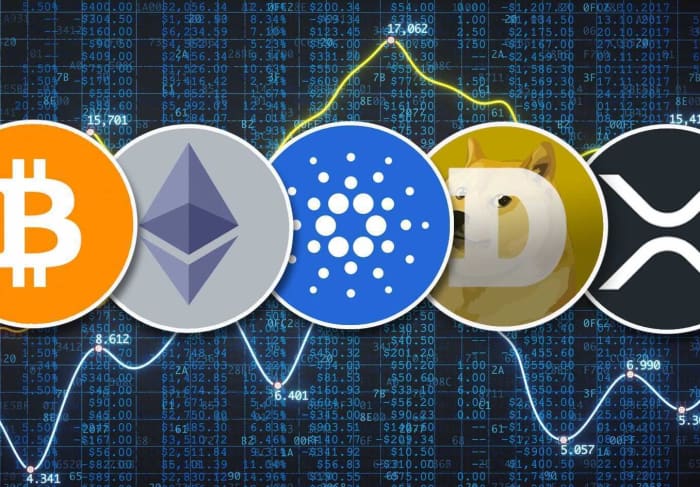
Bitcoin has long been the dominant cryptocurrency. However, as the crypto market has grown in popularity, there has been an increase in the number of developing cryptocurrencies. This begs the question, who are the top cryptocurrency contenders?
As new cryptocurrencies enter the market, investors have a wider range of alternatives to select from. Many of these cryptocurrencies serve distinct purposes and have different ambitions. Every day, it appears like a new sort of cryptocurrency emerges from the woodwork. While others slip under the radar, a handful stands out as the industry’s future leaders, with very strong qualities.
These three cryptocurrencies are serious challengers in the cryptocurrency market.
Ethereum
Ethereum (ETH) is the second-largest cryptocurrency at the moment, making it an obvious pick as a strong contender. The most distinguishing feature of Ether in comparison to other cryptocurrencies is its blockchain platform – Ethereum.
The Ethereum blockchain is distinct from others in that it enables the development and production of new applications such as NFTs. Because Ether is used to pay for such applications, its consumption rate has skyrocketed.
Furthermore, Ethereum does not have a centralized authority and instead allows Ethereum-based programs to function on the network. More infrastructure will be required as the crypto industry expands. Ethereum will meet that demand.
Cardano
One of the most serious worries about the cryptocurrency economy is its carbon footprint. For example, each Bitcoin transaction requires around 1,700 kWh of power. This is more than double the amount used by the average US home.
With current environmental worries and attention, many individuals are hesitant to get on the energy-consuming crypto bandwagon. Cardano enters the picture. Because of its ‘Proof of Stake’ consensus process, Cardano (ADA) is renowned as the green cryptocurrency.
Many cryptocurrencies rely on ‘Proof of Work’ mining, which consumes enormous amounts of electricity. On the other hand, Proof of Stake is dependent on a miner’s percentage of crypto units. It is substantially more energy-efficient since it does not require additional energy to show trustworthiness. Cardano has established itself as the green crypto by being one of the most active adopters of Proof of Stake.
Solana
Solana (SOLpopularity )’s, and price have skyrocketed in the last year. Solana is now the fourth most valued cryptocurrency, and its main selling feature is its speed. Solana can process over 65,000 transactions per second, which is nearly 10,000 times quicker than Bitcoin.
Given how consumers demand to see fast consequences from their efforts, speed is one of the reasons Solana has risen to the top in recent months. Furthermore, with its Degenerate Apes, Solana is one of the most notable cryptos to accept NFTs. Solana’s Degenerate Apes is a series of NFTs featuring dressed apes of different rarity.
Their collection of 10,000 NFTs sold within 10 minutes, causing Solana’s price and appeal to skyrocket. Solana’s price has risen as a result of this shift toward new forms of money, positioning it as a leader in the fight to become a top crypto.
Initially, Bitcoin was the sole cryptocurrency. Every month, a new cryptocurrency contender emerges. As the sector as a whole expands, more and more cryptos will be launched in a quest to become the most valuable and popular alternative.
These cryptocurrencies are currently Bitcoin, Ethereum, Cardano, Solana, and others. Nobody knows who the future leaders will be. However, one thing is clear. Cryptocurrency is fast gaining popularity in the United States and elsewhere.
Over the recent years, tech has advanced the industry of gaming to the extent that numerous games have disposed of the boundary between real life and imagination. Owing to the advancement in tech, the game industry has coped with a wide variety of alterations.
In the modern world, games are employed not just for the intention of entertainment for society, rather for teaching goals in different domains. Particularly, mobile games are thought of as the main driving industry in the current technology realm. In general, one of the most popular virtual games is online casinos, and most people are really delighted with it. If you are one of those people, please press here: online BlackJack.
3D Graphic arts
With the invention of 3D graphics and their exceptional effects, virtual games have been turned into more realistic ones. Specialists have built new tools with the intention of creating real characteristics and including the relationships of the participants in the games. Due to that, extremely special details to every single game enable the participants to be immersed in the virtual world of games feeling a realistic one.
People are interacted by means of virtual games
As video gaming is played with two or many players, the Internet has empowered good friends or siblings to connect and cope with the mission together. It is already plausible to play virtual games at any moment, even if the participants are not virtual. Owing to tech development, many of the websites enable gamers to play in groups as a social happening.
Mobile phones and gaming applications
The virtual game industry has been introduced first by the advent of mobile phones. The gadgets make gaming so plain and more comfortable, so as they are accessible round the clock and relevant to the pocket of every user. If the user has only several spare minutes to game, for instance waiting for a cab or metro, even during this time users can be engaged by virtual game applications using their smartphones.
The payments have become much cozier and secure
Players are empowered to transact without disclosing the identity owing to the progress of the applications’ storage. The methods of virtual protection assure that numeric deals are confined, and laundering money is completely terminated. Applying crypto purses and cryptology enable secure deals, as no information of the partakers is revealed.
Satoshi Nakamoto produced the whitepaper for Bitcoin, one of the most disruptive – if not THE most disruptive – financial and technical discoveries of the modern period, in 2009. Six years later, in February 2015, Thaddeus Dryja and Joseph Poon published their co-authored article titled “The Bitcoin Lightning Network: Scalable Off-Chain Instant Payments,” which significantly increased the Bitcoin network’s scalability.
Since the publication of these two renowned, creative, and significant proofs of concept, the financial industry has moved from skeptics to enthusiastic contributors and adopters of this technology! From Laszlo Hanyecz’s legendary “Bitcoin Pizza” to El Salvador becoming the first country to make Bitcoin legal tender (creating a national use-case for Lightning Network), it is safe to say that we are witnessing a global phenomenon that will shake the foundations of established remittance and global payment infrastructure (s).
Nonetheless, if this is the case, most people would be left wondering, “What is Lightning Network?”
What Is The Lightning Network?
The Lightning Network is an off-chain (Layer-2) system that consists of several payment channels with the goal of reducing value-transfer congestion on Bitcoin’s mainnet, often known as blockchain bloat. What exactly does this mean? Simply defined, the goal of Lightning Network is to improve usability and scalability capacity through the adoption of peer-to-peer payment channels.
In order for these payment channels to exist, at least two parties must be interested in transacting with one another (e.g., a customer and a McDonalds). The consumer (‘payer’) would need to put some Bitcoin (measured in Satoshis or SATs) onto the network to start the payment channel.
Following that, a smart contract is established and encoded with agreed-upon rules that both parties must follow, removing the need for a third-party facilitator and ensuring that both parties fulfill their respective ends of the deal. The receiver (in this scenario, McDonald’s) will issue an invoice to the customer’s wallet informing them that they owe 2,112 Satoshis ($1.29) for the bought McChicken sandwich.
Assume, for example, that the payer is a devoted client who likes purchasing McChicken sandwiches on a regular basis. Fortunately for him, the established payment channel between him and Mcdonald’s may remain open indefinitely, allowing him to buy as many sandwiches as he wants (as long as he has enough Satoshis to cover the bill).
Because Lightning Network is a Layer-2 protocol, transactions between both parties are not broadcast to the Bitcoin main network until the channel is closed. As a result, if both parties agree to stop the payment channel, all transactions carried out through it will be combined and broadcast to Bitcoin’s main network as a single transaction.
The Lightning Network in Numbers
Arcane Research has released a paper titled “The State of Lightning,” which analyzes the exponential expansion of Bitcoin’s lightning network from its inception to its present global acceptance. Although it was formally launched in 2018, the Lightning Network did not see a significant usage increase until September 2021, when it went parabolic, which may be directly attributable to El Salvador’s adoption of Bitcoin as legal cash. El Salvador’s President Nayib Bukele increased his commitment to national Bitcoin adoption by unveiling the Chivo wallet, which now allows over 3 million Salvadorans to pay over the Lightning Network on their mobile telephones.
This news alone sent shockwaves across the remittances sector, demonstrating a significant shift from traditional payment providers and toward permissionless peer-to-peer networks. As the content of payments continues to diversify as additional users get access to Lightning payment, it is unavoidable that Lightning will be used more frequently in daily chores such as merchant payments, bill payments, household expenses, and, of course, remittances.
According to Arcane Research, Lightning adoption in El Salvador might reach almost 90% of the population by 2026, implying a monthly volume increase of $650 million and 20 million transactions for household spending and remittance payments.
On a worldwide scale, all eyes are on El Salvador’s approach’s success. If that happens, other nations will most certainly follow suit, particularly those with hyperinflationary economies, large unbanked/underbanked populations, significant reliance on the US currency, and a heavy reliance on remittances.
With these economic criteria in mind, Arcane Research compiled a list of nations that possess similar characteristics. These nations are predicted to have a combined population of 850 million people, 650 million currently unbanked. If 10% of the predicted population adopts Bitcoin before 2030, there will be 50 million additional Lightning Network users by the end of the decade.
At the time of writing, there are roughly:
There are 17,434 Lightning Network Nodes
78,375 Lightning Channels
A Lightning Network Channel Size of 0.04035309 BTC on average
What Does the Future Hold for the Lightning Network?
Bitcoin and Lightning, as indicated throughout this post, are here to stay for the long haul. The question is no longer whether or when retail consumers will be able to utilize micropayments to buy a gallon of milk or pay their monthly phone bill. Visionaries like Jack Mallers and Jack Dorsey are working to make this a reality with their firms, Strike and, of course, Twitter.
Strike is directly placing lightning network utility in the hands of retail consumers (as seen in El Salvador). Individuals now have the fiat to fast on-ramp required to send money to loved ones overseas without requiring an intermediate business such as Western Union or MoneyGram!
To take this a step further, Twitter has integrated Strike’s services into a new tipping tool that allows Twitter users to transfer microtransactions of Bitcoin to one another! This alone has the potential to change the way we think about the remittance sector. People everywhere now have access to an open, private, tamper-proof, decentralized financial system requiring only a Bitcoin address (or a Twitter account) and a Wi-Fi connection!
Micropayments will eventually go from a budding use-case to a mainstream kind of transactional activity on a worldwide scale. Furthermore, as Web3 ecosystems evolve, these payment methods will encourage the development of a strong gig, machine economy – providing genuine pay-as-you-go capabilities no matter where you are in the globe and truly bringing use invoiced to a whole new and possibly extremely granular level!
Is Floki Inu too comfortable to see the threat posed by emerging cryptocurrencies like HUH token? People may begin to shift their funds to HUH Token, leading Floki Inu to depreciate significantly, triggering market price fluctuations. Investors would naturally compare new cryptocurrencies to see which is more profitable. This article serves as a helpful evaluation and breakdown of Floki Inu and HUH Token, allowing investors to understand both cryptocurrencies better.
Pros of Floki Inu
Usage in the real world
Floki owners are rewarded for having an ambitious road map.
Makes charitable contributions
Cons of Floki Inu
Susceptible to swings
Somewhat reliant on Elon Musk’s help
Some people think of it as a ‘copycat coin.’
Pros of HUH Token
A one-of-a-kind referral program designed to put money, hard cash in your pocket.
Both BNB and Token are distributed.
Refer a friend and they will receive a permanent sales tax reduction from 20% to 10%.
Refer a friend and receive a 10% discount on their first BNB purchase.
You can recommend as many individuals as you want.
The system is intended to generate riches for future generations.
The roadmap for HUH Token is unique and ambitious.
Cons of HUH Token
It has not officially launched yet. It is in its presale stage.
Launch price yet to be confirmed.
We can now compare these cryptocurrencies since you have a better understanding of their capabilities.
HUH Token vs. Floki Inu
The more people that invest in HUH Token, the greater the risk to Floki Inu. As previously said, Floki Inu and HUH Token will undoubtedly be compared, potentially jeopardizing Floki Inu. There are several reasons why HUH Token might become a concern for Floki Inu. To begin with, the Floki Inu concept is comparable to Shiba Inu and Dogecoin, and so the branding is similar in specific ways. If Elon Musk, the CEO of Tesla, had not been so vocal in his support, Floki Inu might not have had the same amount of success.
HUH Token is attempting to stand out in a crowded industry. People unfamiliar with cryptocurrency may be puzzled by it, but HUH Token aims to change that by making it more accessible to the general population. This approach will likely attract a considerable number of new investors, providing HUH Token with a significant advantage over Floki Inu.
It’s worth emphasizing that the entire world has faced some difficult times in recent years. As a result, anything that might be labeled as risky, such as a volatile investment, may no longer be as appealing. HUH Token tried to strike a careful balance between stability and excitement. Investing in Floki Inu, on the other hand, could be seen as high-risk.
One Last Thought
Both cryptocurrencies have pros and cons; nonetheless, the best way to decide where to put your money is to understand your priorities as an investor. You’ll need to narrow down the options available to you and whether or not you’re searching for a quick cash fix or a long-term investment. Taking the time to conduct extensive research is the most effective way to make sound investment decisions.
Follow HUH Token on their Socials before they Launch:
The Metaverse has been the buzz of the town, as aficionados amuse and express interest in this ground-breaking technology. The latest developments of the social media behemoth, Facebook, have shown the importance of this space in the industry. The ventures tethered to the Metaverse have profited significantly recently. There are many new cryptocurrencies forming all the time and innovation is a key area for any successful venture. Decentraland is an innovative concept in itself but the novel and upcoming HUH Token could provide a new paradigm in the cryptosphere.
Decentraland has been grabbing a lot of attention recently in the market. The platform is popular in the world of cryptocurrency and is currently soaring higher in the rankings due to people’s vested interest and fear of missing out. The emergence of Decentraland has been remarkable for traders and experts in the crypto marketplace as they have been able to leverage their knowledge and invest appropriately. Meanwhile, the average cryptocurrency traders are puzzled about the rationale of MANA’s recent climb, which has been inspired partly by Facebook’s journey towards and rebranding to the Metaverse.
Decentraland has been a great challenger for the social giant in this category due to it being decentralized. The latest increase in price has been shocking to even meta aficionados in the community, as the digital asset has outperformed most expectations. There were rumors that Decentraland anticipated the price of MANA to decline after Facebook’s release of META due to a huge and well-known corporate business entering the sector.
However, Decentraland and its challengers are racing forward to emerge as the greatest initiative in the Metaverse market, which has been surprising for the industry, as there was the expectation of mainly big firms and their products leading the way in this tech. Facebooks move into the Metaverse has presented a clear image for holders looking out for investments. It seems to be where the next wave of social technology is migrating to.
Some experts have the view that, while the concept of the Metaverse looks to be illogical in the short term, it offers enormous promise in the future. With predictions of both corporate and the decentralized Metaverse being successful products in the years to come. Whilst initially the execution of these platforms may be slightly better for the corporations, the decentralized products will be offering less restriction and will give the ability to deliver a more open experience.
MANA, according to coinmarketcap today, is trading at $5.10 with an increase of 22 percent in value in the last twenty-four hours. The market cap of the cryptocurrency is at roughly $9,500,000,00, with a trading volume of $6,925,188,840. MANA did also achieve its all-time high of $5.31 in the last week.
The digital coin has surged an incredible 500 percent in a month. Some people are anticipating that the coin might plummet to levels below $3 if it loses out on momentum. Collectively, the success of Decentraland is also related to the fact that the community is developing at a fast rate.
Assimilation is a better tactic than trying to tackle memes or metaverse.
As the self-proclaimed “Utimeme,” the HUH Token intends to harness the enormous potential for social propagation by integrating NFT platform features with a robust, smart contract.
In addition to having a strong social component, in the form of an army of influencers, it also offers a smart chain-based recommendation mechanism. This lets the person who acquires the HUH Token to suggest an endless number of others who do not hold the HUH Token using a code supplied at the time of purchase. The new HUH Token holder’s first purchase is worth 10% of the referral’s purchase on the first purchase transaction. This ten percent is either allocated as Binance Coin or Ethereum, depending on the exchange used for the transaction. This is significant because it enables coin holders to not only produce passive income but also builds stability in their wallets by spreading their investments across various cryptocurrencies. HUH Token also rises in the wallet over time, meaning that the longer you keep it, the more tokens you get.
The HUH Token has allocated an astounding $1,000,000 in liquidity that has been locked in for at least two years in terms of cryptocurrency stability and security. Uniswap and PancakeSwap, the two exchanges where the token will initially be available, will split the liquidity equally.
This coin has also been audited by Shellbox and Solidity Finance, with the Certik audit likely to be completed by the end of this week. The white paper for HUH Token is anticipated to be launched this week, which will assist in identifying the brand’s aims and functioning.
A record-breaking amount of deposits have been made to HUH Token ahead of its presale, which will conclude in only a few days.
Follow HUH Token on their Socials before they Launch:
With the reign of Shiba Inu and the presale success of HUH Token, it’s not surprising that the buzz around the emerging cryptocurrency is firing around the internet like messages through synapses.
With HUH Token’s December 6th release they’ve pledged to plant one million trees for their first one million holders and for that reason, amongst a few, HUH Token might just be the one in a million choice for altcoins over Shiba Inu.
What Else does HUH Token Offer?
HUH Token are much more than their environmentalist endeavors and that’s saying something in a market where almost everyone is out for themselves.
With the impending release of HUH Tokens White Paper, the buzz around the cryptocurrency has risen exponentially from whispers to shouts and the reasons why are new to the crypto world.
HUH Token reimagined the world of cryptocurrency and that’s why it’s a one in a million, maybe more.
Huh Token has created a multichain cryptocurrency that offers the potential of a dual currency. This could mean that HUH Token has made the impacts of a volatile market safer for its holders.
HUH Token uses two well-known blockchains to achieve their one in a million idea, Ethereum, and Binance, this allows HUH Token to skyrocket above other altcoins on the market. That seems to include Shiba Inu as well.
Shiba Inu Pressured to Back Down from Alpha Top Spot
Shiba Inu has been the top dog for some time, but it might not be able to hold onto that for much longer, even with its powerful media techniques.
Shiba Inu found popularity by taking Dogecoin off the top spot as the number one altcoin, but reigns can’t last forever given HUH Tokens online buzz.
Shiba Inu has been one of the favorites amongst crypto lovers, meme fanatics, and generally those who want an alternative to Big Crypto, but HUH Token appear to be coming up on the rear with clear aspirations, the likes that the crypto world hasn’t seen since Bitcoin’s inception in 2009.
It’s time for a change and HUH Token is ready and waiting in the wings to take the altcoin top dog position.
Be A Part of The One in A Million
With HUH Token’s environmentalist endeavors and one-of-a-kind blockchain technology, it would be almost foolish to miss out on its presale state that ends in the coming days.
Holders of HUH Token could potentially benefit from the generational wealth that simply can’t be offered by other altcoins, but the decision is in your hands whether that’s something you’d like to be a part of or not.
In the words of HUH Token’s creators, Hold Until Gold, and that’s exactly what the presale holders will be doing, and you could be one of them.
A limited supply of HUH Token means that through their popularity they’re selling out fast, don’t be the one who misses out.
Follow HUH Token on their Socials before they launch:
When you need to use an ATM, you seek the ideal machine for your needs regardless of the currency. This typically entails opting for an ATM operated by a reputable corporation with reasonable or average costs. You may use the same steps when looking for a Bitcoin ATM (also known as a BTM).
At the moment, every Bitcoin ATM firm charges a nominal fee for people to use their machines. However, why are these levies in place? What exactly do these costs imply? How are they chosen? And why do they differ from one machine to the next? Continue reading to learn more about Bitcoin ATM fees and how they assist operators in delivering better services to you.
What exactly are Bitcoin ATM fees?
Bitcoin ATMs, like standard ATMs, allow you to exchange currency while on the road. Instead of loading money onto a card, you’re depositing cash into a Bitcoin wallet on your phone. Secure identity verification ensures the transaction’s security.
To be deemed legitimate, every Bitcoin transaction must be uploaded to the blockchain. The blockchain is the public ledger that keeps track of all Bitcoin transactions. Miners must validate the transaction before it can be posted to the blockchain.
Miners are incredibly powerful computers that serve as the network’s backbone. The miners who constantly validate transactions on the network provide the network with its decentralized qualities. Miners are rewarded financially in exchange for the electricity and energy they spend to carry out these validations and sustain the network. Each transaction generates a block on the blockchain, and each block adds a block reward. These monetary benefits for miners are included in the fees charged to people who publish transactions on the network.
Bitcoin ATM operators often charge set fees that cover their operating and equipment costs. Some operators incorporate the aforementioned miners’ costs directly into their fixed rates, while others add the miners’ fees (and other expenses) to their advertised percentage fees.
How Does It Work?
Assume you have $100 and want to spend it on Bitcoin. If you only deposit this amount, the fees will be deducted from the total amount deposited. If you want precisely $100 in Bitcoin, you must deposit $100 plus additional cash to pay the BTM operator costs. This includes the operator’s and miner’s fees. In this case, the total Bitcoin ATM costs would be around $10 on average. This is subject to change based on a variety of circumstances.
Why Do Bitcoin ATM Fees Vary?
A number of variables determine transaction costs for Bitcoin ATMs. Depending on the operator, they may include the network, transaction size, and other factors. Each Bitcoin ATM operator has the freedom to set their fees. They must, however, comply with local and national rules.
But what about firms who advertise the lowest possible fees? You want to pay the least amount of money possible, just like you would at a typical ATM. However, when it comes to many operators, you must consider more than simply the advertised charge. Some firms, for example, may keep their advertised price low but then increase the cost of Bitcoin or add on miners’ fees or other costs, boosting the overall charge per transaction.
Let us return to basics and explore some aspects of cryptography in layman’s terms. So, what exactly is cryptocurrency? Cryptocurrency is a sort of currency that takes the form of a digital file. The transaction validation mechanism utilized gives it the term “crypto.”
On the public blockchain ledger, each transaction is cryptographically safeguarded (more info on that momentarily). If you’re curious about how a digital file may be worth anything, see our article on other unusual currencies that were even more “innovative” than cryptocurrencies throughout history.
You may use cryptocurrency to buy goods and services, as well as invest in them. Bitcoin, in particular, has become well-known for the high financial returns it has generated. It was also the first cryptocurrency to be invented and successfully released. It was created in 2008 by the enigmatic Satoshi Nakamoto, as detailed in their Bitcoin whitepaper.
But, aside from Bitcoin, there are other cryptocurrencies. And crypto is about so much more than simply transaction security. Here are the top ten things you should know about cryptocurrency.
What Is the Purpose of Cryptocurrency?
Cryptocurrency was created by a group of people known as cypherpunks who were opposed to government-controlled currency. To overcome this issue, cryptocurrency is decentralized and unaffiliated with any authority.
The goal of bitcoin is to return power to the people. The principle behind decentralization is that no single entity has complete authority over anything. That implies cryptocurrency is a currency that can’t be manipulated or controlled by a government or institution since it’s owned, controlled, and confirmed by every individual and miner on the network.
How Does Crypto Work?
All cryptocurrency is recorded on the blockchain, a public database designed to imitate a physical ledger where transactions are recorded. While the blockchain is open to the public, your name is not associated with any transactions recorded on it. That is part of the allure of cryptocurrency: It provides greater privacy than traditional cash while being transparent owing to its public nature.
While the transactions are recorded on the blockchain, each member of the network has a bitcoin wallet. This is where you save your bitcoin. Because bitcoin is not real, the wallet essentially informs the ledger that you hold “x” quantity of that cryptocurrency.
The blockchain is a network of nodes that validate changes to the public ledger (transactions). The ledger is kept up to current and safe by solving complicated mathematical equations, and the machines that solve those problems are rewarded with Bitcoin. There are two approaches to resolving these issues: Proof of Work and Proof of Investment.
Proof of Work
Individuals make the decision to join the network and mine for cryptocurrency. Their processing power is then applied to solving problems and keeping the ledger up to current and correct. This is the point at which standard Bitcoin mining fails.
Proof of Stake
Whereas Proof of Work requires individuals to determine whether or not to mine, this variant is dependent on the bitcoin you hold. The same procedure is performed, except individuals who “stake,” their coin instead of miners are rewarded.
By doing so, you become a node and contribute to the ledger’s verification and updating. This alternative uses far less energy and is far better for the environment. One example of a cryptocurrency that employs the proof of stake methodology is Ethereum 2.0.
Why Is Crypto So Famous?
Cryptocurrency has grown in popularity in recent years. The high profits and disruptive technology that bitcoin offers are two main elements that contribute to its growth.
Profitable Results
Bitcoin’s value quadrupled in 2020 alone, while several other cryptocurrencies climbed even faster. Cryptocurrency is an incredibly volatile asset that may swing very high and very rapidly. As a result, it has produced thousands of millionaires, as well as a few billionaires. There are about 75,000 Bitcoin wallets valued at more than $1,000,000. And other people have earned billions by capitalizing on the emerging crypto business.
Disruptive Technology
The blockchain technology on which bitcoin is constructed is a major changer across the board, particularly in the financial industry. Decentralization is paving the door for whole new methods to provide products and services.
Many decentralized apps have already been created on Ethereum, posing a challenge to the necessity for traditional institutions. When a technology that challenges the traditional way of doing things is created, it creates a ripe place for creativity and attention.
Most Famous Cryptocurrencies
You’ve probably heard of Bitcoin, the most widely traded cryptocurrency. Ethereum, Litecoin, Cardano, Polkadot, and Bitcoin Cash, which emerged from a Bitcoin split, are among the other cryptocurrencies creating a name for themselves.
The overall bitcoin market capitalization momentarily surpassed $2 trillion. The top six cryptocurrencies account for half of that sum. There are already over 4,000 cryptocurrencies, with more being generated on a monthly basis. Bitcoin was the sole option just a few years ago.
Can I Purchase Cryptocurrency Using Cash?
You may purchase cryptocurrencies with both digital and real money. Buying with actual cash is, in fact, one of our specialties. Convert your excess cash into Bitcoin at one of our Bitcoin ATMs and watch it grow!
What Exactly Is Cryptocurrency Mining?
Consider crypto mining to be similar to gold mine but without the physical effort. Instead, crypto miners use their computers to validate transactions in exchange for a reward in crypto tokens. The transactions they verify are what maintain the public ledger accurate and truthful. To keep supply stable, the incentive for solving these challenges in Bitcoin is half every several years.
What Cryptocurrency Terms Should I Be Aware Of?
There are several phrases that every crypto fan should be familiar with. Here are some of the key terms to understand:
HODL (Hold On for Dear Life)
This basically implies that you should hang on to your bitcoin regardless of what happens in the markets. If it increases sharply or falls sharply, you hodl when you refuse to sell.
NFT (Non-Fungible Token)
A token that possesses an inherent property cannot be swapped for another token. This is a significant simplification, as there is much more to them.
DeFi (Decentralized Finance)
DeFi is a new industry that provides financial services in a decentralized manner over the blockchain network. We are witnessing a trend away from centralized services (banks) and toward open-to-all, decentralized services.
What Will the Future of Cryptocurrency Look Like?
The future of cryptocurrencies appears to be bright. It has witnessed a significant increase in acceptance over the last year, as well as a lot of media coverage. As inflationary pressures mount, more investors are turning to Bitcoin as a hedge.
Crypto is becoming more popular among younger people. Coinbase was listed on the New York Stock Exchange. Bitcoin ATMs are becoming increasingly popular. When you combine this with the fact that more investment institutions are enabling their consumers to participate, it is evident that the cryptocurrency sector is only getting started.
Should I Put Money Into Cryptocurrency?
At the end of the day, only you can answer this question. Cryptocurrencies are incredibly volatile, and there is still guesswork involved. As with any investment, conduct your research beforehand. In addition, consider the degree of danger you are willing to accept. Don’t put money into investments that you can’t afford to lose.
As with any new technology, beginners to the world of crypto have a lot of questions. How long does it take for a Bitcoin transaction to be reflected in my account? Can I move funds across Bitcoin wallets? How long does it take to transfer money between Bitcoin wallets?
When it comes to your money, it is critical that you feel secure in each transaction and empowered in your understanding of how your money is managed. We will help you feel more prepared by answering some of the most frequent questions you may have about making Bitcoin transactions.
How Long Does It Take for a Bitcoin Transaction to Complete?
The time it takes to complete a Bitcoin transaction might vary depending on a number of factors. To begin, it is critical to understand how a Bitcoin transaction works. Person A, for example, desires to transfer some of their Bitcoin to Person B, both of whom already have wallets. Each Bitcoin has its unique BTC address, which indicates who owns it.
Person A gives the Bitcoin a new address to deliver it to Person B by transferring it. After Person A initiates the transaction, it must be validated on the blockchain by Bitcoin miners. Person B can locate the Bitcoin in their separate digital wallet once the miners have verified the transaction.
But how long does it take to verify? A Bitcoin transaction will typically take between 10 minutes and an hour to complete. However, a few things can influence how long it takes. One consideration is traffic. As with any technology, the more people who try to access something simultaneously, the slower it will respond.
The second factor is operator sensitivity. Some operators take longer than others to process fees and transactions before the miners even validate them. As a result of the added step, each transaction through exchanges may take longer.
How Long Does it Take to Transfer Bitcoin From One Wallet to Another?
Assume you’re ready to send some Bitcoin to a buddy or transfer Bitcoin from one of your wallets to another. How long should a transaction between Bitcoin wallets take?
Like any other Bitcoin transaction, switching Bitcoin from one wallet to another necessitates altering the BTC address, checking the blockchain, and completing the transaction between wallets. However, because it is a more straightforward act, it is usually a considerably speedier process than regular transactions.
Transferring Bitcoin between wallets takes between ten and twenty minutes on average.
How Do You Move Bitcoin From One Wallet to Another?
So you’ve set up your wallets and are ready to transfer money between them. How do you move Bitcoin from one wallet to another?
The first step would be to log into your account and examine your current wallet. Choose the wallet from which you want to transfer Bitcoin and the amount you want to transfer. Next, you’ll need the address of the wallet where you intend to deposit your Bitcoin. This will need their providing you with their BTC address. You can begin the submission procedure once you have the address. This will differ significantly depending on the wallet you choose. Once you’ve submitted the transfer, it’ll be up to your wallet to validate and finalize the transaction between the two wallets, which could lengthen the process.
It isn’t easy to go anywhere these days without seeing new ways to pay with cryptocurrency or new varieties of cryptocurrency emerge. The popularity of cryptocurrency and Bitcoin is only going to grow. As more people start using this new currency, more questions will surface.
There are numerous ways to cash out your Bitcoin, ranging from cryptocurrency brokers to exchanges to Bitcoin ATMs. Consider them as alternative ways to the same destination. Some people favor speed, while others prioritize security, and still, others prioritize both!
Here, we dissect the numerous alternatives.
The Need for Speed in Peer-to-Peer
Bitcoin peer-to-peer services allow you to get cash rapidly with little to no additional fees, but it is a multi-step process that is not suitable for beginners. To begin, you must pay to place an ad stating how much Bitcoin you wish to sell. Following that, you choose a pay-out method, such as a cash deposit into your bank or PayPal account.
Escrow features and rating systems are available on several P2P platforms to assist buyers and sellers. Nonetheless, the P2P technique necessitates expertise with protocols such as demanding evidence of a buyer’s identity, verifying a buyer’s payment account details, and understanding that payments you receive can be reversed.
You can also engage in direct trades with individuals, either online or in person. This is as close to peer-to-peer as it gets. As with any other transaction involving valuable things and/or face-to-face meetings, it’s advisable to proceed with caution to ensure you’re selling to a reliable buyer. Always conduct your research!
Brokers and Centralized Exchanges: Similar to Limousines
Because they provide comparable user experiences, brokers and centralized exchanges are frequently addressed together. Brokers and exchanges, like limos, are widely available and run seamlessly.
To cash out your Bitcoin, you effectively put it up for sale by depositing it into your broker or exchange account. You sell the Bitcoin, receive cash in your account, and then withdraw it–typically via wire transfer to a bank account. Some brokers allow withdrawals to PayPal accounts.
The procedure is simple, but brokers and exchanges may charge hefty transaction fees and require you to wait up to six days before the funds are credited to your account. Remember that while limousines provide comfort and safety, they are not known for their quickness.
BTMs with Bitcoin Debit Cards: Safe and Quick
Two-way Bitcoin ATMs, which enable you to purchase and sell Bitcoin, provides a user-friendly, convenient, and safe method of cashing out. What’s the best part? You can get your money right away. You can use a Coinsource BTM to transact as little as $5 and as much as $5,000 every day, and Coinsource’s fees are among the lowest for BTM operators in the United States. This is an excellent solution for many people who want to convert Bitcoin into cash swiftly and securely.
Bitcoin debit cards, which are Visa or Mastercard-backed debit cards linked to your Bitcoin wallet or preloaded with Bitcoin, are another alternative. A Bitcoin debit card is used in the same way as a bank debit card is used. Use it in physical stores and online, regardless of whether the seller accepts Bitcoin. You may even withdraw money from a conventional ATM, which immediately transforms your Bitcoin into fiat currency. You can effectively cash out your Bitcoin by doing so.
Notable: Bitcoin credit cards are on the way!
According to Investopedia, “You may pay withdrawal, transaction, or monthly account fees with a Bitcoin debit card.” Keep in mind that because Bitcoin’s price varies, the quantity of Bitcoin required to complete a transaction can fluctuate, even within a single day.”
Summary
Recognizing your priorities is the most critical step in deciding how to cash out your Bitcoin. When do you need your money? What kind of costs are you willing to pay? What non-negotiable security procedures do you take? These questions are all important in determining your method of cashing out Bitcoin.